Stars are among the most important objects in the universe because they produce the light and energy that make life possible. A star forms when enormous clouds of gas and dust collapse under gravity. As the material compresses, temperatures rise until nuclear fusion begins in the star’s core. This process releases vast amounts of energy in the form of light and heat. Stars come in many different sizes, colors, and temperatures. Some are much smaller than the Sun, while others are hundreds of times larger. Throughout their lives, stars change and evolve before ending as white dwarfs, neutron stars, or black holes.
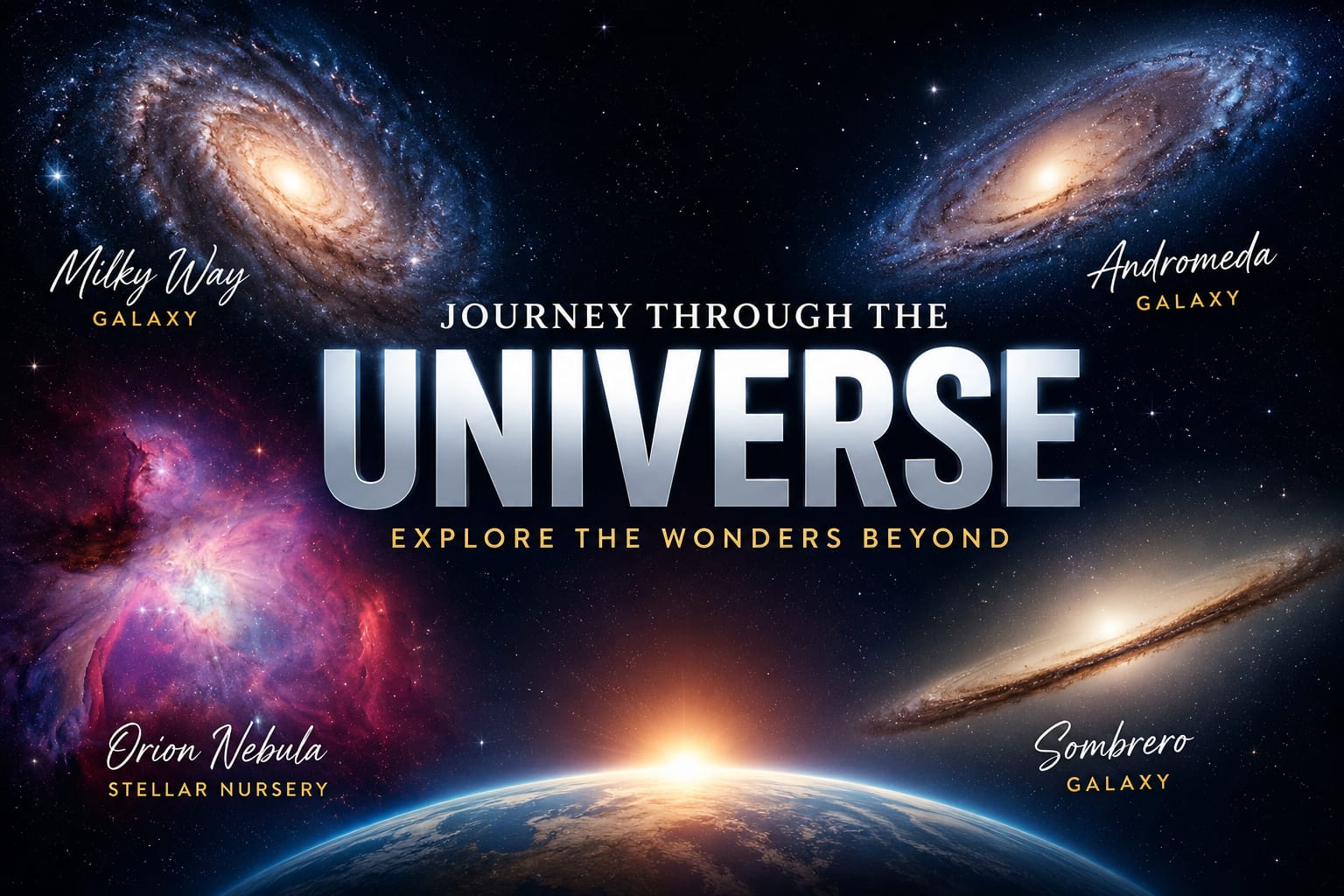
Nebulae are giant clouds of gas and dust found throughout galaxies. They are often called stellar nurseries because they are the birthplaces of new stars. The Orion Nebula is one of the most famous examples and can even be seen with the naked eye under dark skies. Within these colorful clouds, gravity pulls gas together until new stars begin to shine. Nebulae also form when massive stars explode, spreading heavy elements throughout space that later become part of new stars and planets.
Our Solar System is only a tiny part of the Milky Way Galaxy. It consists of the Sun, eight planets, dwarf planets, moons, asteroids, comets, and countless smaller objects. Earth is the only known planet
that supports life, thanks to its atmosphere, liquid water, and suitable temperature. Scientists continue searching for Earth-like planets around distant stars, hoping to discover whether life exists elsewhere in the universe.
One of the greatest mysteries in astronomy is the existence of black holes. A black hole forms when a very massive star collapses under its own gravity. Its gravitational pull becomes so powerful that nothing—not even light—can escape once it crosses the event horizon. Supermassive black holes exist at the centers of most galaxies, including the Milky Way. Although black holes cannot be seen directly, astronomers detect them by observing how nearby stars and gas behave under their immense gravitational influence.
Another fascinating mystery is dark matter and dark energy. Ordinary matter, which makes up stars, planets, and people, accounts for only a small fraction of the universe. Scientists estimate that dark matter makes up about 27 percent of the universe, while dark energy accounts for roughly 68 percent. Although these invisible components cannot be observed directly, their effects on galaxies and the expansion of the universe are clearly measurable. Understanding them is one of the greatest challenges in modern astronomy.
The development of advanced telescopes has revolutionized space exploration. Ground-based observatories allow astronomers to study distant celestial objects, while space telescopes avoid the distortion caused by Earth’s atmosphere. Modern observatories have captured breathtaking images of galaxies, nebulae, and exoplanets, revealing details that were once impossible to see. Robotic spacecraft have visited every major planet in our Solar System, landed on Mars, flown past Pluto, and explored comets and asteroids.
Space exploration has become an international effort involving scientists and engineers from many countries. Missions to the Moon and Mars have expanded our knowledge of planetary science, while satellites continuously monitor Earth and study the Sun. Future missions aim to establish long-term human presence on the Moon, send astronauts to Mars, and search for signs of life on distant worlds. Every mission contributes valuable information that helps us better understand the universe.
Astronomy has also changed the way we think about ourselves. Looking into the night sky reminds us that Earth is only one small planet orbiting an ordinary star in one galaxy among billions. This perspective encourages international cooperation, scientific curiosity, and a greater appreciation for our home planet. The elements found in our bodies were created inside ancient stars billions of years ago, meaning every human is, in a very real sense, made of stardust.
The future of astronomy is brighter than ever. Artificial intelligence, next-generation telescopes, and increasingly sophisticated spacecraft will allow scientists to study the earliest galaxies, detect more Earth-like planets, and investigate the deepest mysteries of space. Questions about the origin of the universe, the nature of dark matter, and the possibility of extraterrestrial life continue to inspire researchers across the globe.
The universe is a place of endless beauty, mystery, and discovery. Every star, galaxy, and nebula tells a story that stretches across billions of years. Astronomy not only helps us understand the cosmos but also reveals the incredible history of our own existence. As technology advances and exploration continues, humanity will undoubtedly uncover even more astonishing secrets hidden among the stars, reminding us that the greatest adventure of all is the journey to understand the universe itself.
 1. Milky Way Galaxy


Milky Way Galaxy: Our Cosmic Home
The Milky Way Galaxy is the massive spiral galaxy that contains our Solar System. It stretches across the night sky like a glowing band of stars and is home to billions of celestial objects. Scientists estimate that it contains between 100 and 400 billion stars, along with countless planets, nebulae, and mysterious black holes.
At the center of the Milky Way lies a supermassive black hole called Sagittarius A*. Our Solar System is located about 27,000 light-years away from this center, in one of the galaxy’s spiral arms known as the Orion Arm.
Interesting Facts
- Diameter: About 100,000 light-years
- Age: Around 13.6 billion years
- Shape: Barred Spiral Galaxy
- Contains billions of stars and planets
 2. Andromeda Galaxy


Andromeda Galaxy: Our Nearest Galactic Neighbor
The Andromeda Galaxy is the closest large galaxy to the Milky Way and is located approximately 2.5 million light-years from Earth. It is also the largest galaxy in our Local Group.
Scientists believe that in about 4.5 billion years, the Milky Way and Andromeda will collide and merge to form one enormous galaxy. Despite this collision, the vast distances between stars make direct star-to-star collisions extremely unlikely.
Interesting Facts
- Distance: 2.5 million light-years
- Diameter: About 220,000 light-years
- Shape: Spiral Galaxy
- Visible without a telescope under dark skies
 3. Sombrero Galaxy


Sombrero Galaxy
The Sombrero Galaxy is one of the most recognizable galaxies because of its bright central bulge and dark dust lane, giving it the appearance of a traditional sombrero hat. Located about 31 million light-years away, it contains billions of stars and a massive black hole at its center. Its unique shape and brilliant glow make it a favorite target for astronomers and space telescopes.
 4. Whirlpool Galaxy


Whirlpool Galaxy
The Whirlpool Galaxy is one of the finest examples of a grand-design spiral galaxy. Located about 23 million light-years away, it is famous for its well-defined spiral arms filled with bright young stars. The Whirlpool Galaxy is interacting with a smaller companion galaxy, and this gravitational interaction is triggering new star formation. It is one of the most photographed galaxies by both amateur and professional astronomers.
 5. Pinwheel Galaxy


Pinwheel Galaxy
The Pinwheel Galaxy is a stunning face-on spiral galaxy located about 21 million light-years from Earth. It is even larger than the Milky Way, measuring around 170,000 light-years across. Its graceful spiral arms contain countless young stars, glowing nebulae, and star-forming regions. Because of its beautiful structure, it is considered one of the most spectacular spiral galaxies visible through telescopes.
 6. Black Eye Galaxy


Black Eye Galaxy
The Black Eye Galaxy is famous for its striking dark dust band that appears like a black eye across its bright nucleus. Located about 17 million light-years away, this spiral galaxy has an unusual internal structure where gas in the outer regions rotates in the opposite direction to gas near the center. This feature suggests it may have merged with another galaxy in the distant past.
7. Cartwheel Galaxy


Cartwheel Galaxy
The Cartwheel Galaxy is one of the most unusual galaxies ever discovered. Located approximately 500 million light-years from Earth, it has a spectacular ring-shaped appearance that resembles a giant wagon wheel. Scientists believe this structure formed when a smaller galaxy passed directly through its center billions of years ago. The collision created expanding rings of gas and dust where intense star formation continues today. The Cartwheel Galaxy provides valuable insight into how galaxy collisions shape the evolution of the universe.
Orion Nebula


Orion Nebula: A Stellar Nursery
The Orion Nebula is one of the brightest nebulae visible from Earth. Located in the Orion constellation, it is famous as a stellar nursery where new stars are born from massive clouds of gas and dust.
Astronomers study the Orion Nebula to understand how stars and planetary systems form. It is visible even with small telescopes and binoculars under clear skies.
Interesting Facts
- Distance: About 1,344 light-years
- Type: Emission Nebula
- Also known as: Messier 42 (M42)
- One of the brightest nebulae in the night sky
Sombrero Galaxy


Sombrero Galaxy: The Galaxy with a Hat
The Sombrero Galaxy is one of the most visually striking galaxies in the universe. Its bright central bulge and dark dust lane resemble a traditional Mexican sombrero hat, giving it its popular name.
Located around 31 million light-years away, this galaxy contains billions of stars and an exceptionally massive black hole at its center.
Interesting Facts
- Distance: About 31 million light-years
- Also known as: Messier 104 (M104)
- Shape: Unusual Spiral Galaxy
- Famous for its bright nucleus and dark dust ring
Conclusion
The universe is filled with extraordinary cosmic wonders, from the familiar Milky Way Galaxy to the majestic Andromeda Galaxy, the star-forming Orion Nebula, and the uniquely shaped Sombrero Galaxy. Each of these celestial objects helps scientists uncover the mysteries of space while inspiring us with their breathtaking beauty. As technology advances, our understanding of the cosmos continues to grow, reminding us that there is still so much left to explore beyond our world.